Are AI Influencers Legal? Disclosure Rules for 2026
Yes, AI influencers are legal in most countries. But in 2026 you have to be open about two things: that the content is AI-generated, and that a post is paid. Here is what each rule requires.
The short answer
Running an AI influencer is legal in most places. The rules are about transparency and rights: label realistic AI content, disclose paid partnerships, and never use a real person’s face, voice or name without permission.
This is general information, not legal advice. Rules differ by country.
European Union: AI Act, Article 50
Since 2 August 2026, Article 50 of the EU AI Act requires anyone who publishes realistic AI-generated or manipulated content (“deep fakes”) to disclose that clearly. The European Commission published guidelines on these transparency rules in 2026.[1] If people in the EU can see your posts, assume it applies to a realistic AI persona.
United States: FTC Endorsement Guides
There is no special federal AI influencer law, but the FTC’s Endorsement Guides apply. Any “material connection” with a brand, such as payment, free products or affiliate commission, must be disclosed clearly, whether the creator is human or virtual.[2] Endorsements must also be honest: an AI persona cannot claim to have used a product it never used in a way that misleads people.
Instagram, Facebook and TikTok
Platforms have their own rules on top of the law. Meta requires creators to label photorealistic video and realistic audio that was digitally created or altered, and may penalise accounts that do not.[3] TikTok asks creators to label AI-generated content that shows realistic scenes or people.[4]
Likeness, voice and copyright
- Real people: do not create a persona that looks or sounds like a real person, especially a celebrity, without written permission. Many countries protect a person’s likeness and voice.
- Trademarks: do not put brand logos on products in AI images unless you work with that brand.
- Tool licences: check that your image, video and voice tools allow commercial use of what you create.
- Copyright in AI images: protection for purely AI-generated images is limited or unclear in many countries, which matters if you plan to license or sell the persona.
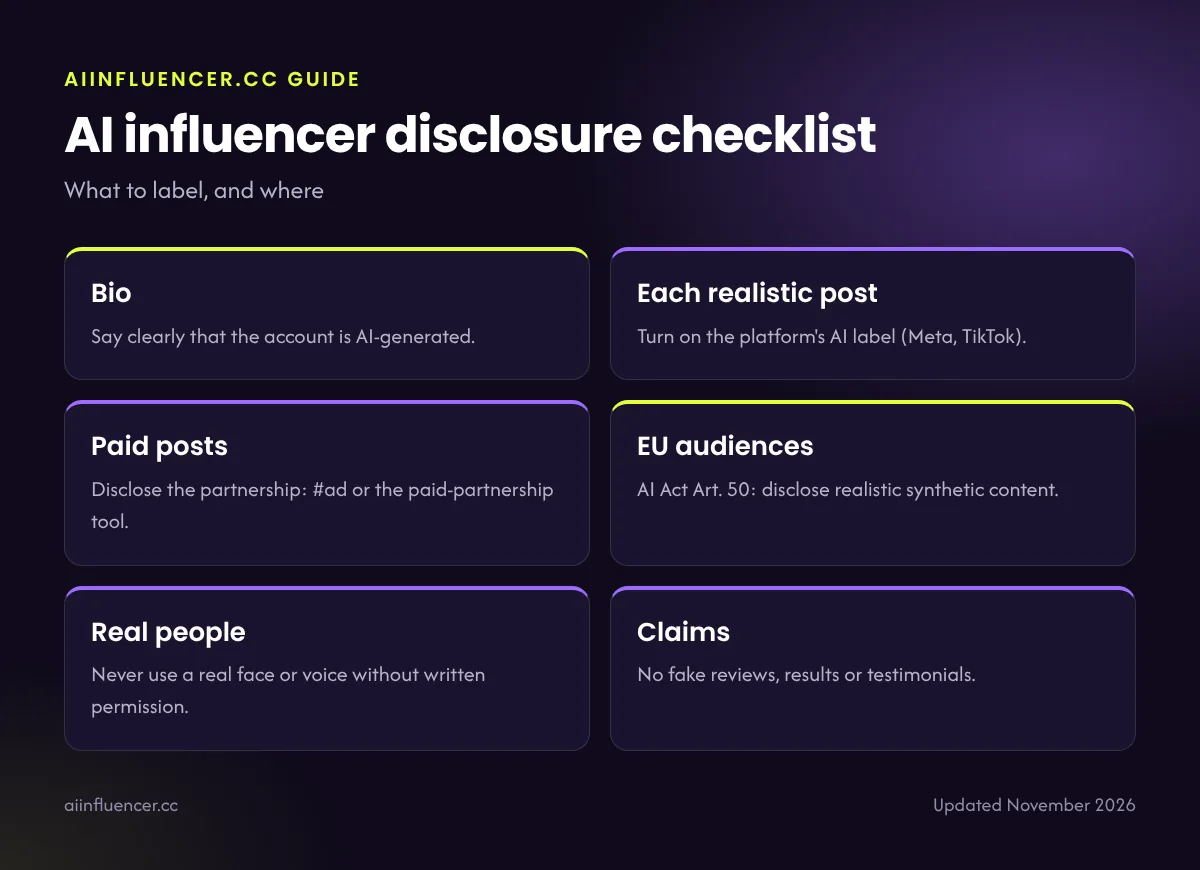
AI influencer legal checklist
- “AI-generated” in the bio of every account
- Platform AI label switched on for realistic posts
- #ad or the paid-partnership tool on every sponsored post
- Original face and voice, not based on a real person
- Commercial rights confirmed for every tool you use
- No fake reviews, results or testimonials
- Contracts with brands that mention the persona is AI
More on this in the rules section of our main guide and in virtual influencer rules.
FAQ
Frequently asked questions
Is it legal to create an AI influencer?
Yes, in most countries, as long as you follow advertising and disclosure rules and do not use real people’s likeness without permission.
Do AI influencers have to say they are AI?
In practice, yes. The EU AI Act requires disclosure of realistic AI content, and Meta and TikTok ask for AI labels on realistic posts.
Do AI influencers need to disclose sponsored posts?
Yes. Paid posts must be disclosed exactly as they would be for a human creator.
Can I make an AI influencer that looks like a celebrity?
No. Using a real person’s likeness without permission can break the law and platform rules.
Sources
- Paul, Weiss, EU finalises transparency rules for AI-generated content
- U.S. FTC, FTC’s Endorsement Guides: What People Are Asking
- NPR, Meta will start labeling AI-generated images on Instagram and Facebook (2024)
- TikTok Support, AI-generated content
Keep reading
Related guides
The complete AI influencer guide
What AI influencers are, how they earn, the tools and the rules, all on one page.
What is a virtual influencer?
Where virtual influencers came from and how brands use them.
How to create an AI influencer
The full step-by-step process, from character brief to first brand deal.
3 Comments