AI Influencer Virtual influencer
What Is a Virtual Influencer? Meaning, History and How They Work
A virtual influencer is a digital character, not a real person, that builds an audience on social media and works with brands. Here is how they started, how they are made today, and what brands and creators should know.
Virtual influencer: definition
A virtual influencer is a computer-generated character with a name, personality and social media accounts, run by a company or creator. It posts content, grows followers and promotes products like a human influencer, but the person you see does not exist.
Virtual influencer
The wide term. Includes 3D and CGI characters made by studios, cartoon-style mascots, and AI-generated personas.
AI influencer
A virtual influencer made mainly with generative AI tools. Most new personas since 2023 are made this way. Our AI influencer guide
Types
Types of virtual influencers
CGI / 3D characters
Built by 3D artists and studios, often frame by frame. Examples: Lil Miquela, Shudu, Imma.[2–4]
High quality and full control, but slow and expensive to produce.
Brand mascots
Owned by a company and used as the face of its products. Example: Lu do Magalu from Magazine Luiza.[5]
Very stable characters that can last for decades.
AI-generated personas
Made with image, video and voice AI, often by a single creator. Examples: Aitana López, Kenza Layli, Mia Zelu.[6–8]
Cheap and fast to produce, the fastest-growing type.
History
A short history of virtual influencers
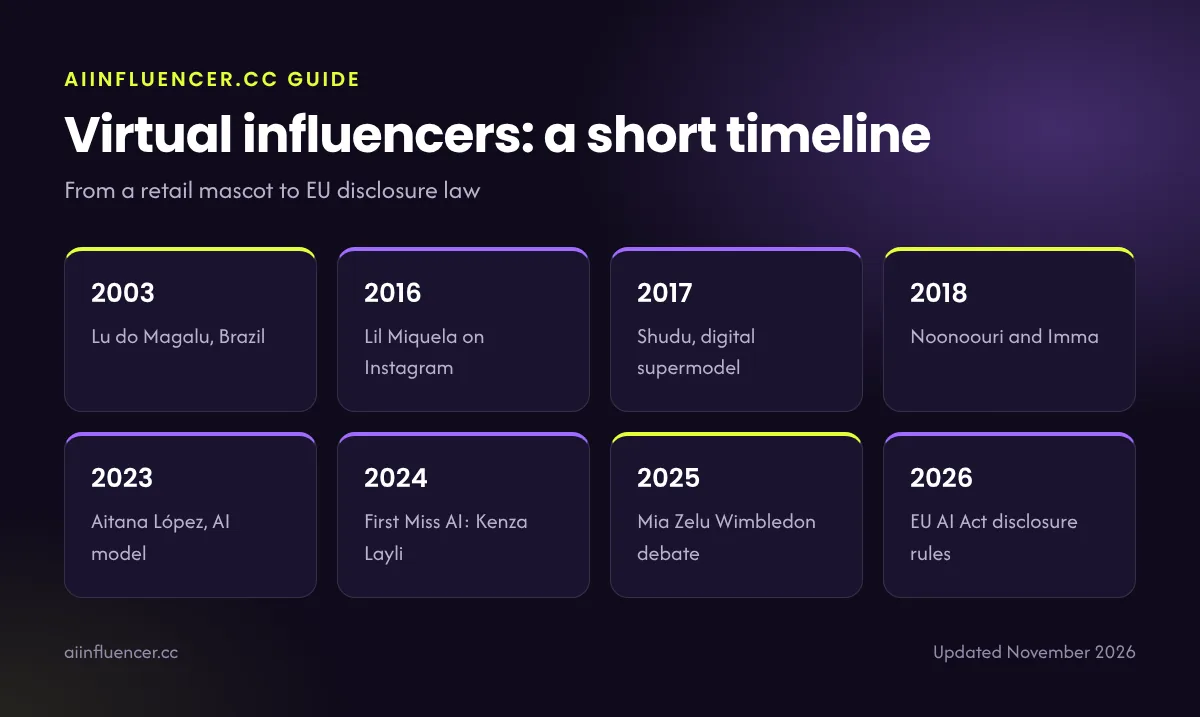
2003
Lu do Magalu is born
Brazilian retailer Magazine Luiza creates Lu as a digital assistant. She later becomes one of the most followed virtual influencers in the world.[5]
2016
Lil Miquela appears on Instagram
Created by the Los Angeles startup Brud, Miquela becomes the best-known CGI influencer and works with fashion brands. Dapper Labs buys Brud in 2021.[2,9]
2017
Shudu, the “first digital supermodel”
Photographer Cameron-James Wilson posts Shudu in April 2017 and later founds The Diigitals, an all-digital modelling agency.[3]
2018
Noonoouri and Imma
Noonoouri, a stylised fashion character, works with luxury houses. In Japan, Imma becomes the country’s best-known virtual model.[4,10]
2023
Generative AI arrives
Barcelona agency The Clueless launches Aitana López, an AI model that earns from brand deals and subscriptions.[6]
2024
The first “Miss AI”
Moroccan AI influencer Kenza Layli wins the first Miss AI contest, run by the World AI Creator Awards with Fanvue.[7]
2025
Mia Zelu goes viral at Wimbledon
Fabricated photos of an AI persona at Wimbledon fool many viewers and start a debate about AI influencers pretending to be human.[8]
2026
Disclosure becomes law in the EU
Article 50 of the EU AI Act requires clear disclosure of realistic AI-generated content from 2 August 2026.[11]
Production
How virtual influencers are made today
1. Character design
A brief defines the name, look, personality and values. This is what makes followers care.
2. Visuals
Studios use 3D software. Solo creators use AI image generators with a locked face. See the best AI image generators.
3. Motion and voice
AI video and voice tools turn stills into Reels and talking-head clips. See the best AI video generators.
Want to make one? Our step-by-step guide covers the full process.
Business
Why brands use virtual influencers
Advantages
- Full control over every post and message
- No scandals, scheduling problems or burnout
- Content in any location or language
- The character can last for years
- A 2022 Swinburne study found virtual influencers can be as effective as human ones[12]
Disadvantages
- Audiences may trust them less when products need real experience
- Making high-quality CGI is expensive
- AI personas can look fake if the face drifts
- Disclosure rules add work
- Criticism over unrealistic beauty standards
Criticism
Risks and criticism
The biggest concern is deception. When an AI persona posts as if it were a real person at a real event, as in the Mia Zelu Wimbledon case, followers can be misled.[8] Critics also point to unrealistic beauty standards, and to brands using diverse-looking characters without hiring diverse people.
For creators, the practical risks are platform penalties for unlabelled AI content, and legal trouble from using a real person’s likeness. Both are avoidable: label the account, and design an original face.
Rules
Disclosure rules for virtual influencers in 2026
- EU: Article 50 of the AI Act requires clear disclosure of realistic AI-generated or manipulated content from 2 August 2026.[11]
- US: the FTC Endorsement Guides apply. Paid posts must be disclosed, whether the creator is human or virtual.[13]
- Platforms: Meta and TikTok ask creators to label realistic AI content.
More detail in are AI influencers legal? and the rules section of our main guide. Also see AI vs human influencers.
FAQ
Frequently asked questions
What is a virtual influencer?
A computer-generated character that runs social media accounts, builds an audience and works with brands, while being operated by a company or creator.
What is the difference between a virtual influencer and an AI influencer?
Virtual influencer is the wider term and includes 3D and CGI characters. An AI influencer is a virtual influencer made mainly with generative AI tools.
Who was the first virtual influencer?
It depends on the definition. Lu do Magalu dates from 2003 as a brand assistant. Lil Miquela, from 2016, is usually called the first modern Instagram virtual influencer.
How do virtual influencers make money?
Brand deals and sponsored posts, affiliate links, subscriptions, licensing, and for brand-owned characters, sales of the company’s own products. See how AI influencers make money.
Are virtual influencers legal?
Yes, in most countries, as long as you follow advertising and disclosure rules and do not use real people’s likeness without permission.
Sources
- Virtual Humans, The most followed virtual influencers of 2022
- Wikipedia, Miquela
- Virtual Humans, The latest from Cameron-James Wilson, Shudu’s creator
- Storyclash, Virtual influencers
- Virtual Humans, Lu do Magalu in the 2022 ranking
- Euronews, Meet the first Spanish AI model earning up to €10,000 per month (2024)
- SheThePeople, Kenza Layli becomes the world’s first Miss AI
- Tennis.com, AI influencer Mia Zelu went viral at Wimbledon
- TechCrunch, Dapper Labs acquires virtual influencer startup Brud (2021)
- Wikipedia, Noonoouri
- Paul, Weiss, EU finalises transparency rules for AI-generated content
- Swinburne University, Research finds robots are coming for our influencers (2022)
- U.S. FTC, FTC’s Endorsement Guides: What People Are Asking
Keep reading
Related guides
The complete AI influencer guide
What AI influencers are, how they earn, the tools and the rules, all on one page.
How to create an AI influencer
The full step-by-step process, from character brief to first brand deal.
Best AI image generators
The image tools compared for realistic, consistent influencer photos.
See virtual influencers in action
Nine real examples and what each one teaches.